 Hematology Division Head in King Abdulaziz Medical City - Jeddah, Dr. Ahmed Alsaeed confirmed that the success of bone marrow transplant procedures in Princess Noorah Oncology Center (PNOC) at the Ministry of National Guard – Health Affairs - Western Religion, depends on having a highly efficient medical team as well as the availability of necessary equipment and technologies, in addition to the major role of the overall coordination process handled by Nurse Coordinator, Roaa Gassas. All these three elements guarantees the completion of any transplant procedure, and this is witnessed by the Department of Hematology and bone marrow transplant for more than two years, since the beginning of the bone marrow transplant program.
PNOC is considered a mega project for the MNG-HA, due to its high cutting-edge care and state-of-the-art technology and equipment. Dr. Alsaeed stated that so far, 60 cases of bone marrow transplant have been carried out successfully, ranging from Autologous (Self) and donors transplants for various different types of in bone marrow diseases for both adults and children. He also pointed out that bone marrow transplants is now becoming a hope for a lot of people with malignant tumors, especially if the patient is diagnosed with Leukemia or lymphoma. Dr. Alsaeed also added that PNOC receives more than 2,000 cases of solid tumors every year and around 300 cases of leukemia, according to the Information Storage Unit, which is one of the PNOC’s achievements.
On this regards, a medical team at the Bone Marrow Transplant Program - PNOC – has successfully treated a leukemia patient through a bone marrow transplant from a relative donor. It is known that resorting to the bone marrow transplant treatment - or what is also called stem cell transplant – takes place when the blood cells are damaged leading to what is known as blood diseases, such as leukemia, or the bone marrow is unable to keep up with the body's need for healthy blood cells.
There are several types of stem cell transplant for cancer treatment, allogeneic stem cell transplants use cells from a close family member (usually a brother or sister) whose tissue type closely matches the patient’s. Compared to Autologous (Self) transplant, the allogeneic stem cell transplants requires a highly skilled medical team, as the patient is exposed to a morbidity rate by 15%.
This type of stem cell transplant for cancer treatment has been used in treating this cancer patient by a medical team, led by Hematology and Bone Marrow Transplant Consultant, and head of Adults Bone Marrow Transplant Program, Dr. Zayed Al Zahrani.
 Regarding this case, Dr. Al Zahrani said that the patient was suffering from leukemia, and she was not responding to the use of international authorized conventional treatment methods, Therefore, our option was the stem cell transplant, and it has been decided that the stem cell donor would be her brother, after the lab results that showed that their tissue were identically matched. Dr. Al Zahrani also added that, before conducting the stem cell transplant for the patient, practical measures through several stages were carried out, including, psychological and emotional support, physical preparation which includes a strict diet with a dietitian, in addition to educating the patient and the donor of all health issues related to stem cells transplant, as well as presenting the case to another specialist other than the case assigned one, to avoid duplication in the decision to conduct the procedure by the patient and the donor.
After that, the necessary tests and examinations phase starts, which includes a full blood work to test for viruses, along with the heart, lung, kidneys, and liver functions. After checking the safety of both the patient and the donor, the treatment phase starts by giving the patient intensive doses of chemotherapy in order to kill all blood cells. This phase was carried out successfully without causing any damage to the patient or any complications that could have led to stopping the treatment.
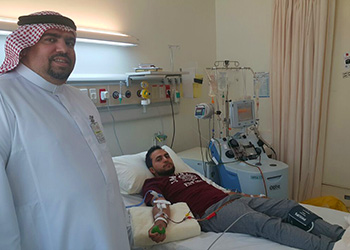
At the same time, the donor was given booster doses to stimulate the stem cells for a period of five days, then the medical team collects the cells by a device called “Spectra Optia” a modern stem cell collection device, in which the process will last for approximately four to six hours, depending on the donor’s weight and the amount of produced stem cells in the body, and after the end of the collection phase, the stem cells will be injected in the patient through an intravenous catheter, very similar to giving blood for any patient and not injecting the stem cells in the bone as most people imagine.
Thankfully, the transfer process was completed and the donor left the hospital at the same day, while scheduling regular visits in order to avoid any complications. Meanwhile, the patient was given immunosuppressive drugs to prevent the rejection of the transplanted stem cells, and this is a very critical stage, as the patient may develop serious infections that might lead to death.
Last but not least, in such cases, the patient will stay in the hospital for a period of 4-6 weeks, until the platelets count is elevated as well as the immune system. After the patient was discharged, she had 2 to 3 a week follow-up visits in the oncology clinic until reaching the end of the scheduled 3-month treatment plan, where a blood work is conducted to confirm total remission, which means that tests, physical exams, and scans show that all signs of cancer are gone.
Dr. Al Zahrani lastly pointed out that despite the complications of the transplant procedure with a death rate of 15%, as well as the financial cost could reach more than one million, the patient's life without this procedure was threatened by 100%.