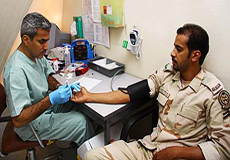
 The Blood Donor Center in King Abdulaziz Medical City - Riyadh celebrated the Blood Donor Day on Sunday, June 14, 2009 for its fourth year in a row. It honored all the donors that regularly give blood – some gave more than 100 times - and rewarded such donors with thanks, gifts and certificates of appreciation.
The Center handles two kinds of donations, whole blood donations where a person can donate every two months (or eight weeks) depending upon the ability of the donor, and platelet donations that can be done twice a week but not more than four times a month for the health of the donor.
The platelets have a shelf life of five days and thus the Center is always in need as platelets are continuously used with critical cases in the hospital such as the case with oncology patients. As for the whole blood, it is separated within the hospital into red blood cells (RBC) which stay up to 42 days, plasma which has a shelf life of 1 year, and the platelets.
Moreover, there are usually three kinds of donors; family members, volunteers and a donors program that differs between military and civilians. On the Blood Donor Day, the Blood Donor Center carried out two programs; one for the military which was held in the Center and the other for civilians which was held in various Kingdom female high schools. The day before, the Center had more than 110 donors.
Blood donation can come in many forms either from the initiative of the Center or from the organizations themselves whether they are educational or business.
The Blood Donor Center supervisor Mahasin Al Musa commented how grateful they were to all their donors. She also mentioned the various stages of donation. “Donors have to have certain qualifications to be able to give blood. They have to be over sixteen years of age, more then 50 Kg and have their national ID with them if they are Saudi nationals and if they are not Saudi then all they need is their Iqama.”
At the KAMC Blood Donor Center the first thing donors need to do is register. Then, they will be required to answer a list of questions and have their vital signs checked. Furthermore, the staff will check both medical and travel history to see if they fit the preconditions.
If the donor passes all requirements then he or she will have their blood drawn. The procedure usually takes from ten to fifteen minutes then the donor will be given some nourishment and time to rest.
All the information will be recorded for the future. At times the Center will contact regular donors to inform them of certain events such as the case with the Blood Donor Day this year.
Mahasin Al Musa pointed out that with rising awareness, the rate of people donating blood has been increasing in Saudi Arabia where now the average donors in the Kingdom has reached eighteen thousand per year.