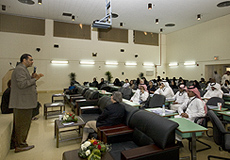
The activities of the Health-care Workshop for Health Workers at King Abdulaziz Medical City concluded on Tuesday, August 18, 2009. The workshop was organized by King Saud Bin Abdulaziz University for Health Sciences in collaboration with the World Health Organization, the International Labour Organization and Centers for Disease Control and Prevention, Ohio, USA.The workshop was held between 15-18 August in the postgraduate training center.
On the last day a presentation was given by the technical officer of the occupational and environmental health in the World Health Organization, Dr. Susan Wilburn where she addressed patient’s rights, ensuring information confidentiality and work ethics.
The senior medical officer and chief of the national surveillance team in the National Institute for Occupational Safety and Health (NIOSH) Ohio – USA Dr. Ahmed Gomaa presented a study about the mechanisms and policies of preventing the transmission of bloodborne pathogens in the work place.
The EPINET program supervisor in Virginia, Ms. Ginger Parker gave the last practical training session on how to use the program. It aims to provide information, reports and graphs about the patient history which would reduce the numbers of transmission of bloodborne pathogens. The program is available in more than 20 languages and the Arabic version is still in progress.
The workshop was concluded with an open dialogue about developing some schemes to control and prevent infections in the Middle East, the possibility of changing health policies, developing training materials that fits the needs of trainees and the development of medicine curricula in general and nursing in particular.
Ms. Ginger Parker expressed her happiness with the audience’s constructive interactions and commended trainees’ eagerness to know every detail. Moreover, Dr. Janine Jagger noted the detailed comprehensive reports prepared by the trainees about what they have learned in the EPINet program and their ability of transferring the knowledge to a larger group in King Abdulaziz Medical City departments.
Dr. Ahmed Gomaa praised the practical side of the session and the role experts played in educating the trainees about the program and how it works. He explained how Ms. Ginger Parker provided technical support to the trainees not only during the session but in the future by communicating with them via e-mail and telephone not to mention conducting future workshops.
Furthermore, Dr. Janine stressed the importance of translating the EPINet program to Arabic, since it is the number one language in the Gulf region, noting how the time has become "more favorable" now due to the large number of users in the region.