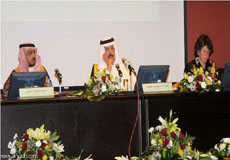
 In a ceremony held at King Abdulaziz Medical city National Guard - Riyadh on 27-10-2010, and on behalf of HRH Prince Mitib bin Abdullah, Deputy Commander National Guard for Executive Affairs, His Excellency Abdulmohsen Al-Tuwaijri, Assistant Deputy Commander of the National Guard launched the first phase of the Saudi Arabian National Guard Integrated Electronic Disease Surveillance System (SANG-IEDSS) in cooperation with Centers for Disease Control and Prevention (CDC) in the United States of America with the presence of U.S. ambassador in Riyadh Mr. James Smith and Admiral Nicole Lurie, Assistant Secretary for Preparedness and Response - Department of Health and Human Services.
His Excellency Abdulmohsen Al-Tuwaijri, Assistant Deputy Commander of the National Guard mentioned the importance of the epidemiological survey of hospitals in the National Guard, pointing out that the program is of high quality and hopes to provide excellent medical services for all patients of National Guard Health Affairs.
Moreover, Dr. Bandar Al Knawy, the Chief Executive Officer, National Guard Health Affairs, President, King Saud bin Abdulaziz University for Health Sciences and General Supervisor, Royal Clinics said that King Abdulaziz Medical City has a well established reputation and made great efforts in the area of infection control, making it the best place to base a regional center for GCC Infection Control, which was inaugurated in 2005.
It is worth mentioning that preparing a unified directory similar to that utilized in the United State's CDC is underway, seeking to facilitate the process of registering cases of infection within hospitals to sufficiently prepare case reports to eliminate the spread of epidemics.
Furthermore, Dr. Hanan Balkhi the Executive Director of the Infection and Prevention Control Department in the National Guard Health Affairs pointed out that the program is being used across the four hospitals affiliated with the National Guard, and after the completion of the initial assessment, the program will attract a larger number of hospitals to participate in it.