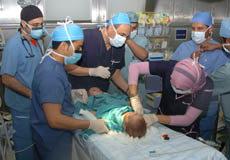
 Yesterday evening, His Excellency Minister of Health, Dr. Rabeeah along with more than 60 of his multidisciplinary team led a very successful separation of Egyptian twins Hassan and Mahmoud. These twins became the 21st set to be separated by Dr. Rabeeah and his surgical team at King Abdulaziz Medical City in Riyadh.
The 9 month old twins are in stable condition in the pediatric intensive care unit (PICU) after the remarkable separation. After that, they will be taken to Ward 7 where they will continue their recovery.
The surgery went through eight phases starting with the twins undergoing anesthesia at 7:45 am. It lasted nearly an hour and a half.
By 10:00 am, the sharing of the bowel was identified and separation of the bowel was performed without failure. It was found that the adhesion in the bladder neck and urethra was larger than expected.
Phase six began with separating the pelvic bones. By 6:15 pm the medical team reached the seventh phase and the twins were separated. Both were transferred to independent surgery tables to start the restoration process. The twins were successfully separated and both Mahmoud and Hassan were placed in separate beds for the first time.
The pediatric consultant, Dr. Mohammed Al-Namshan said in a press meeting during the surgery that the phases of the separation of the Egyptian conjoined twin went as smoothly as planned.
He added that the anesthesia was successful and lasted an hour and a half instead of 3 hours, pointing out that the twins were stable and there was no complications.
The consultant plastic surgeon, Dr. Abdullah Al-Thunyan said that the separation surgery had 3 alternative plans (a,b,and c)in case there had been an emergency. One of the plans was to use artificial tissues for closing wounds and to cover open parts after the separations. However, he said that no artificial tissues were used.
The surgery was the first for Dr. Rabeeah since his appointment of Minister of Health earlier this month and it was expected to last 15 hours. However, they had finished three hours ahead of schedule. The twins moved to separate beds around 4:35 pm before being taken to the PICU.
The separation of the twins was displayed live over the hospital's conjoined twins internet website with up-to-date information on the twins surgery as it progressed. Pictures and videos of the twins were also displayed for its viewers. Around 45 local, Arab, and international TV channels were covering the separation of the conjoined twins. During the surgery, medical team staff were live on the air to give immediate updates about the surgery.
A number of viewers interacted with the surgery of separating the Egyptian conjoined twins. Members of the medical staff reported about the separation live on the TV channels including the head of the surgical team Dr. Abdullah Al-Rabeeah.
Hassan and Mahmoud are Ischiopagus twins, initially joined by the pelvis and lower abdomen. In this type of twin, some of the organs are shared including the genitals, kidneys, and bladders.
The twins are the third set of Egyptian twins operated on at King Abdulaziz Medical City in Riyadh. The first set of twins, Egyptian girls Talya and Taleen were separated in 2003. The second set of Egyptian twins, Alaa and Walaa were separated in 2005. All the twins were separated successfully.