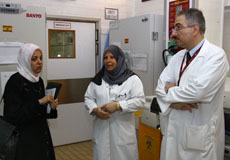
 Dr. Bandar Al Knawy, the CEO of National Guard Health Affairs and the President of King Saud bin Abdulaziz University for Health Sciences, launched a health-care program for health workers on August 15, 2008 in the Postgraduate Center.
The program is organized by King Saud University for Health Sciences in collaboration with the World Health Organization and will continue for three days until August 18, 2009.
The first day of the training program was attended by a select group of national and international doctors.
The goal is to protect health workers against exposure to bloodborne infections and to provide a policy to protect them, utilizing the third edition of the EPINET program.
The program was opened by the senior medical officer and chief of the national surveillance team in the National Institute for Occupational Safety and Health (NIOSH) Ohio – USA Dr. Ahmed Gomaa. He gave a presentation which addressed the effectiveness of some procedures in preventing diseases and discussed out how to raise awareness about the risk of transmission of bloodborne pathogens in the work place.
Later on, Dr. Ziad Memish, the executive director of infection prevention and control and the head of the organizing committee in KSAU-HS gave a presentation about the efficiency of control measures and post-exposure follow-up: Reporting, Testing, PEP.
Participating in the workshop was the technical officer of the occupational and environmental health in World Health Organization Dr. Susan Wilburn. She gave a presentation entitled Needlestick Prevention Committees: Intro to using data for prevention. Furthermore, a presentation entitled "epidemics caused by bloodborne infections” was given by Dr. Janine Jagger the director of the International Health Care Worker Safety Center in Virginia, USA, who also presented the third edition of the EPINET program dealing with the historical background of the program, its contents, previous editions and the scope of its uses globally.
The first day of the program was concluded with an open dialogue about the lessons learned from the risks of exposure to pathogens transmitted by blood, taking examples from four African countries and the Middle East. It was followed by a practical training session on the EPINET program in both Arabic and English, by Dr. Janine Jagger and the program supervisor in Virginia, Ms. Ginger Parker.