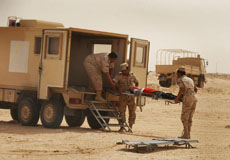
King Abdulaziz Hospital in the National Guard - Al-Ahsa had a training drill that spotlighted how to act in case of an accidental petroleum material explosion. The drill succeeded in saving 28 wounded, 32 people were injured, and 2 were killed. The hypothetical experiment was carried out by the Military Field Medicine of the eastern province. This drill reached a great success rate of 95% according to the organizers.
This drill comes after a series of periodic experiments and hypothetical situations carried out by the National Guard Health Affairs in the in the eastern province. According to the Chief Executive Officer of the NGHA and the President of King Saud bin Abdulaziz University for Health Sciences Dr. Bandar Al Knawy that this drill comes to evaluate the potential to deal with such important incidents.
Dr. Al Knawy said: “The NGHA always carries out such drills and hypothetical situations so that it can be prepared in case they happen.” He mentioned that the National Guard studies the pros, cons and shortcomings that need to be addressed and that through previous drills they achieved continued success. He also stressed the importance of each team member knowing exactly his responsibility do deal with such incidents in the future.
The Regional Executive Director of the National Guard Health Affairs in the Eastern province Dr. Ahmed Alarfj assured that these experiments prepare the working team to cope with such incidents and not be surprised in the future because they have experienced such a realistic event. Furthermore, medical skills are acquired from these training sessions. He also mentioned that this drill was carried out to study the possibility of receiving and handling even greater numbers of emergency cases.
The commander of the field military medical team in the eastern province, Brigadier Mohammed Al-Shamarri pointed out that the Civil Defense in the National Guard received a call in the morning regarding an explosion of petroleum material and that 30 people were injured. In a record time they were able to put out the fire, and 20 ambulances reached the emergency ward at King Abdulaziz Hospital where there was a full alert to receive casualties.
Brigadier Al Shammari said: "According to the drill, 2 had died and 8 had severe injuries. The rest varied between mild and less than average injuries. The question we were eager to answer was how to handle such situations if they occur. The medical, nursing and technical teams were highly professional in handling the conditions. Usually, such drills are carried out in complete secrecy and are not disclosed to measure their pros and cons. This drill reached a success rate of 95% and the 5% will be dealt with in the future.”
He also pointed out that the drill was reviewed the next day and after viewing the specially placed surveillance cameras and discussing points of error, future improvements were highlighted.