National Vaccination Campaign Against Polio
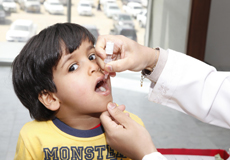 The National Guard Health Affairs in Jeddah concluded the activities of the National Vaccination Campaign Against Polio on 29 February 2012 the campaign targeted vaccinating all children under age of five and nearly 2,000 children. The campaign is carried out in two doses, the first dose for five days andwhich was completed on Wednesday and the second will be from April 7 to April 11, 2012.
Polio is an old disease which was first discovered in 1350 by ancient Egyptians, and since that time humanity had suffered from its effects on the child’s health and the society.
It is an infectious diseases caused by a virus that affects the nervous system leading to paralysis in a very short time. This enterovirus is transmitted orally through polluted food or drink, then spreads to the lymph glands in the throat or intestines where it multiplies and attacks the nervous system. It then attacks the motor neurons in the spinal cord or the brain. Symptoms represent in high temperature, fatigue, headache, vomiting and pain in the limbs.
These symptoms range between simple and high-risk, such as paraplegia and sometimes even lead to death in case if it affects the part of the brain that controls breathing. Paralysis occurs in about 1 out of 200 cases and 5-10% of those affected might die.
There are 3 types of the polio virus. In most cases, it affects children under the age of five. With the World Health Assembly resolution WHA41 made in May 1988 the World Health Organization announced its commitment to eradicating polio in the world. After that infection rates dropped by more than 99%. However, in 2011, it was discovered that there are still some cases in developing countries (such as Nigeria, India, Afghanistan, and Pakistan), the existence of a single case means that there is a risk of the disease spreading and such vaccination programs as well as epidemic surveys are imperative in getting rid of polio and other infectious diseases.
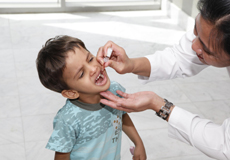 The government in the Kingdom of Saudi Arabia inits efforts to stop this diseases enforces vaccinating infants based on the Expanded Programme on Immunization (EPI). Children are ammonized through basic and supplementary doses within the program, two drops in the mouth. Moreover, there are national comprehensive vaccination campaigns such as the Polio Eradication Campaign which are implemented on a national level, vaccinating all children the age of five years and under with two doses of the polio vaccine (four to six weeks between doses).
Our government through the Ministry of Health has adopted eradicating this serious disease, which encourages health workers in all sectors to achieve this goal. And in collaboration with those efforts the National Guard Health Affairs adopted a mass vaccination program against polio to make sure that all employee children under five are vaccinated. Due to the sensitivity of the vaccine precautions were taken to protect it and nurses have been educated on how to deal with cold chain the vaccine, and a brochure was distributed in this regard.
Health teams were formed, each team had two male nurses and two female nurses, and geographic detailed maps were distributed for each team with the address of streets and residents to be covered. Also, schedules were coordinated to cover all housing units in city so that each team covers 140 units during the campaign.
The campaign will be from 2 - 6 pm in the compound in Jeddah and from 5 - 8 pm in King Abdulaziz Medical City.
The 2nd step is health education to raise health the public’s awareness about the seriousness of polio and preparing an intensive plan to stress the importance of vaccination campaigns and their schedules as well as clarifying the role of parents in the success of these campaigns.
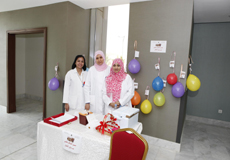 The Center of Prevention and Community Medicine coordinated 15 field teams to vaccinate the children of National Guard employees in the compound. Also, vaccinating children under age of five in primary healthcare centers as well as those who have not been vaccinated.
The National Guard Health Affairs had the cooperation of the Department of Medical Supply in the primary health care within the Ministry of Health through providing adequate vaccines for the target group, plus 20% in case of any unexpected increase or any loss of vaccine.
Furthermore, NGHA coordinated with the College of Nursing at King Saud bin Abdulaziz University for Health Sciences and with a group of health and military institutions to participate in this campaign. Also, available in its headquarter during the five days of the campaign male and female physicians to deal with medical conditions that may occur.
The campaign covered all the targeted areas without any problems or obstacles and successfully vaccinated approximately 400 children a day.