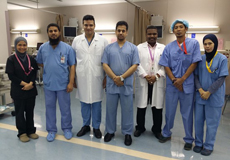
A medical team in KAMC-Jeddah successfully performed a complex spinal surgery for a patient in his fifties. The patient had difficulties in controlling his lower limbs and with walking. After close examination, it was clear that the patient had developed a spinal tumor which in turn caused high pressure on his spinal cord. As a result, the patient was unable to walk and lost bladder control.
The case presented is considered a rare case; therefore, the medical team had performed a close check-up for the patient to determine the cause of the pressure on the spinal cord; plus taking a sample using radiation methodology which helped in identifying the type and the clinical behavior of the tumor.
This kind of cancer requires blocking all blood vessels nourishing the tumor prior to any surgical intervention due to the large amount of veins and arteries in the tumor as they could cause major bleeding during the surgery and such complication could lead to the patient’s death.
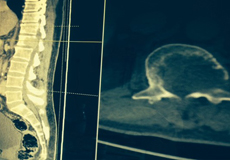 The medical team headed by Dr. Mohammed Khashab, and two other members, Dr. Hatim Al Shareef, and Dr. Mohammed Khalifa explained that this type of cancer usually causes severe pain in allocated in the back and sometimes accompanied by partial or complete paralysis due to the cancer spreading in the neurocanal causing high pressure on the spinal cord and the nerves. Furthermore, Dr. Fawaz Al Shareef and Dr. Turki Al Hazmi from the Vascular and Interventional Radiology Division in KAMC-J were able to block all veins and arteries nourishing the tumor prior the surgery in order to reduce any bleeding could occur during the surgery.
In addition, Dr. Mohammed Khashab declared that the surgery was very complicated and lasted 9 hours in order to remove the tumor and place a front supportive pillar in the affected vertebra by making only one opening on the back.
It is worth to mention that such complicated case in which the cancer surrounds the nerves from both sides, front and back usually requires an opening in the chest to isolate and secure the infected veins and relive pressure on the spine then the front part of the tumor is removed; in addition to making another opening at the back to remove the back part of the tumor and release the veins and finally a surgical fixation with metal screws is performed.
The patient now is fully recovered and able to walk again with no bladder control issues.