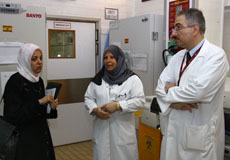
 In a response to the possible spread of the swine flu, the World Health Organization (WHO) visited the National Guard Health Affairs – Riyadh laboratories to evaluate the ability of the center to meet the health needs of citizens in regards to the swine flu and influenza in general. As a technical officer of WHO, Dr. Hala Tolba took a tour of the hospital and its several laboratories. Accompanying Dr. Tolba in her extensive tour were several representatives from the NGHA.
She asked a number of questions regarding how the labs function and the staff’s levels of preparedness. She reviewed the protocol for handling such cases like the swine flu, while Dr. Ziad Memish, Executive Director of Infection Prevention and Control stated that NGHA was currently waiting for CDC kits to arrive and that it was held at a high priority.
In an effort to obtain more information about the current situation, several questions were posed to Dr. Tolba. Currently the pandemic is at phase 5, however given effective measures, this could possibly be demoted to a lesser stage in the future. The two antiviral medications used to manage the viruses, Zanamivir and Oseltamivir, were considered to be effective both as a prophylactive and as treatment with few side effects. Dr. Tolba explained that the symptoms for swine flu are similar to those for seasonal flu; namely fever, aches and pains, upper respiratory distress, and in about 20% of the people it could result in diarrhea and vomiting.
According to Dr. Memish, the flu remains communicable (possible to pass from one person to another) from one day before symptoms begin to about one week after. It is currently not known how long these viruses remain viable on surfaces such as money or doorknobs; therefore, it is prudent to be cautious with objects that a patient had come in contact with. As the virus is still new, it is very difficult to determine how fast or in what manner the virus can evolve into other variations. As more international cases have come to the attention of the medical profession, it may appear that the rate of infection has increased, but more likely it has reached a plateau and is beginning to decrease. Containment policies are therefore important. Also mentioned was the necessity of implementing national plans to dealing with similar situations, such as making sure labs are prepared to handle required testing. Furthermore, it is prudent to have medications and masks available in sufficient quantities, and most of all educating the public about the situation and the preventive measures to deal with the disease.
Currently no known cases of the swine flu have been detected or recorded within the Kingdom of Saudi Arabia.