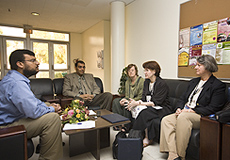
The World Health Organization (WHO) held a workshop to protect healthcare workers against contagious diseases and to prevent blood-borne pathogens.In an interview with WHO experts, Centers for Diseases and Control and Prevention (CDC), and Virginia University, the NGHA covered the workshop thoroughly.
Dr. Susan Wilburn, Technical Officer, Occupational & Environmental Health for WHO, says, the workshop’s general objectives are to assist the leaders in healthcare and workers in the region to raise awareness against blood-borne pathogens. It also trains the healthcare professionals on EPINet data selection surveillance program to prevent needle stick injury and exposure to contaminated blood.
Describing the EPINet software that is compatible with Microsoft applications, Dr. Ginger Parker, EPINet administrator in the International Health Care Worker Safety Center, University of Virginia, says it is a simple computer program to collect data and in turn sends it to the computer to generate data to see whether the hospital professionals are injured or exposed to any blood-borne pathogens. It helps the hospital take a proper decision if it sees it applies any risky measures.
“The picture is changing now,” says Dr. Ginger referring to the importance of input data inserted into the EPINet software. “If you do not have data, you really do not know what’s going on, unless certain people complain. Keeping that data helps the hospitals evaluate how they are improving.”
Dr. Janine Jagger, Director of International Health Care Worker Safety Center, University of Virginia, talks about what she terms “Power of Numbers” in EPINet. She says the more people communicating, the more data gets magnified, explaining that in terms of preventing exposure to blood-borne pathogens, the more people share their experiences, the more powerful data becomes. “Data and the impacts will proliferate as the trainees here will train others across the region.”
Dr. Janine says that EPINet gives an actual picture of how events go. It helps the healthcare workers define and understand the challenges lying ahead to be ready with customized solutions. “The data describes problems related to products used in hospitals as they might communicate diseases. The data speaks to manufacturers about defects to be handled like their need to change designs of their devices to avoid likely problems. In short, it helps manufactures recognize their products. “
Dr. Ahmad Gomaa, Senior Medical Officer and Chief of National Surveillance Team, National Institute for Occupational Safety and Health (NIOSH) and expert at the (CDC), supports Dr. Janine’s viewpoint of “Power of Numbers”. He says it helps produce the best medical devices and guides the manufactures on what to do to improve their products.
Drawing a comparison between the past and present, Dr. Susan Wilburn said before EPINet and other systems monitoring the injuries, healthcare workers wondered what wrong they did to be affected with disastrous injuries. “Now, this EPINet has been very powerful to show which problems with systems and devices cause the injuries so that prevention can occur. The individuals are no longer alone as they have a system to support them; it tells them the circumstances that contribute to the exposure and what can be done.”
Susan has warned against the increasing number of healthcare workers getting affected with infectious diseases around the globe. She says 80% of healthcare professionals in certain countries in the Middle East, North Africa and the Arabian Gulf countries get affected with Hepatitis because of exposure to blood-borne pathogens, according to a WHO study conducted in 2002-2003. This is why the WHO endorsed a plan of action to protect healthcare workers.
“The WHO launched an international campaign to immunize the healthcare workers. This immunization was a bit more complex than any other immunization as it requires three doses,” said Susan. “This shows how the countries help the hospitals to make sure that their healthcare workers are protected against Hepatitis B which is almost completely preventable. So it does not matter if they exposed to it as they have immunity,” she added.
On hierarchy control measures to prevent blood-borne pathogens and exposure, Dr. Ahmad Gomaa discusses certain measures adopted to prevent exposure from happening and gives examples of that. “For example, if we want to prevent sharp injury of healthcare workers, we need to look at every problem to see whether it is necessary to use sharp tools to begin with or to replace them with a medication by mouth to get rid of the risk of sharp injury. Another example, gluing a straight cut in the arm is better than suturing it to get rid of the peril of sharp injury. “
Dr. Gomaa added, “There are lots of mechanisms to apply to isolate exposure from the person on the job. For example, after using an injection, the sharp must be retracted into the syringe before it is put immediately into the garbage not to communicate pathogens to cleaners. This way is one of the best care approaches to prevent exposure to the patients.”
He calls for educating the people on how to protect themselves by taking vaccinations if pre-required. He calls upon the hospital management to draw up policies and procedures to create a safer environment for the healthcare workers. He advises the healthcare professionals about the hierarchy measures, “Concentrate on elimination of hazards, safety of devices, education, elimination, safe culture, and taking care of yourselves before taking care of the patients.”
Along the same vein, Dr. Janine stresses the importance of reporting every incident to guide the health care professionals because if an incident is not recorded and an infection occurs, the professionals will forgo all the potentials and will intervene after the exposure occurs. She gives an example of Hepatitis C which is treatable and the earlier that is treated, the sooner recovery can take place.
On the difference between exposure to blood-borne pathogens and to swine flu, Dr. Janine says the easiest way to describe the difference is that exposure to blood is a stuff people can see and exposure to flu is that stuff people cannot see. This is why the researchers’ ways to describe the two things are completely different.