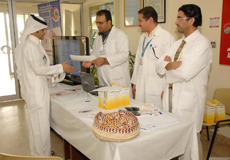
King Abdulaziz Hospital in the National Guard Health Affairs -Al-Ahsa held events to celebrate the World Breastfeeding Week with the attendance of more than 520 people over two consecutive days. The days held discussions on a number of prevailing topics and questions about breastfeeding. The target audience included National Guard employees and visitors who came to participate. Patents asking all kinds of relevant questions and discussions regarding the topic which demonstrated parents desires to change the current situation.
Zahra Al-Basri, a breastfeeding consultant and health promotions services specialist in King Abdulaziz Hospital – Al-Ahsa and the organizer of this event said: “The main objective of this event is to raise awareness and rectify prevailing mistaken beliefs about breastfeeding.”
One of the stressed topics revolved around breast milk in the first days after birth, mentioning that it is very different and distinct from the milk in later days. It was explained that the reason for the small amount of milk produced is due to the baby’s small stomach which does not require large quantities of milk. Furthermore, breast milk contains natural laxatives in the first days to help remove the viscid fluids the baby’s intestines are full of after birth.
Al-Basri also said that many of the mothers mistakenly follow the habit of using various herbs for the baby in his/her early days. World medical organizations advise against giving the baby any herbs until one year of age to avoid any harmful chemicals that these herbs may contain. They warned against the danger these non-sterilized herbs may present, which are always taken from herbal stores and directly fed to the baby.
Dr. Hammam Kandil, a consultant in neonatology and neonatal ICU said: “UNICEF called for breastfeeding in 1991 and developed Ten Steps to Successful Breastfeeding. As such, the late King Fahad had issued a royal decree to protect breastfeeding and reduce the use of formulas.”
The World Breastfeeding Week celebrated breastfeeding to encourage the rerun to natural breastfeeding. Accordingly, a group of KAMC specialists dedicated two awareness days to explain the health risks of formula feeding and distributed gifts and health awareness brochures.
Some of the problems facing breastfeeding are misunderstandings, social customs and beliefs by new mothers as well as the availability of formula milk in stores and supermarkets something that is banned locally and globally.
Dr. Kandil added that society is witnessing formula marketing campaigns that include physicians promoting the use of formulas, taking advantage of mothers who need milk or who have to work. In response, the World Health Organization created health-friendly instructions to resolve the problem by including tips to increase the secretion and storage of milk in appropriate ways, and then feed the baby without the need for resorting to formulas.
He pointed out that in cases of twins or premature births, world organizations had succeeded in helping mothers to breastfeed for six whole months then to gradually start adding food supplements to the milk and continue without the need of using formula milk.